We are a small independent game developer located in Warsaw, Poland. Before The Astronauts, some of us worked on games like Painkiller and Bulletstorm.
Our latest project is Witchfire, a dark fantasy first person shooter set in an alternative world in which witches are real and very dangerous – but so are you, witchhunter.
Our first game was a weird fiction mystery titled The Vanishing of Ethan Carter. The game has won many awards, including BAFTA, and we sold over one million copies. It’s available on PC, PS4 and Xbox One. Click here for more details.
We’re steaming ahead towards 1.0 and looking forward to talking about all the things coming your way when it lands, but it’s still a bit too soon for that.
This, however, does not mean that we cannot celebrate Halloween – an occasion quite close to our hearts, especially since Witchfire is no tale of sunshine and rainbows, but rather one of horror and the grotesque.
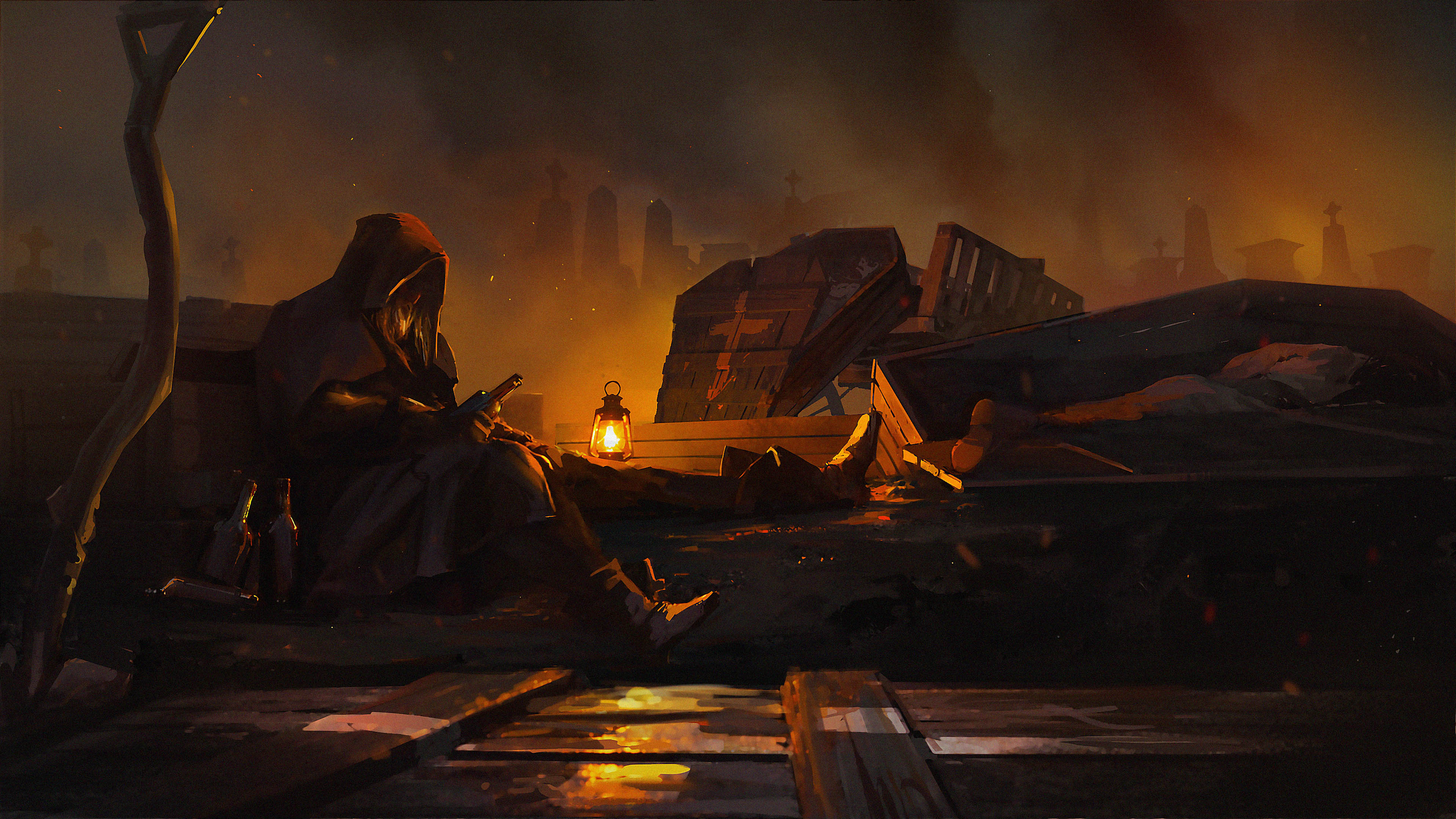
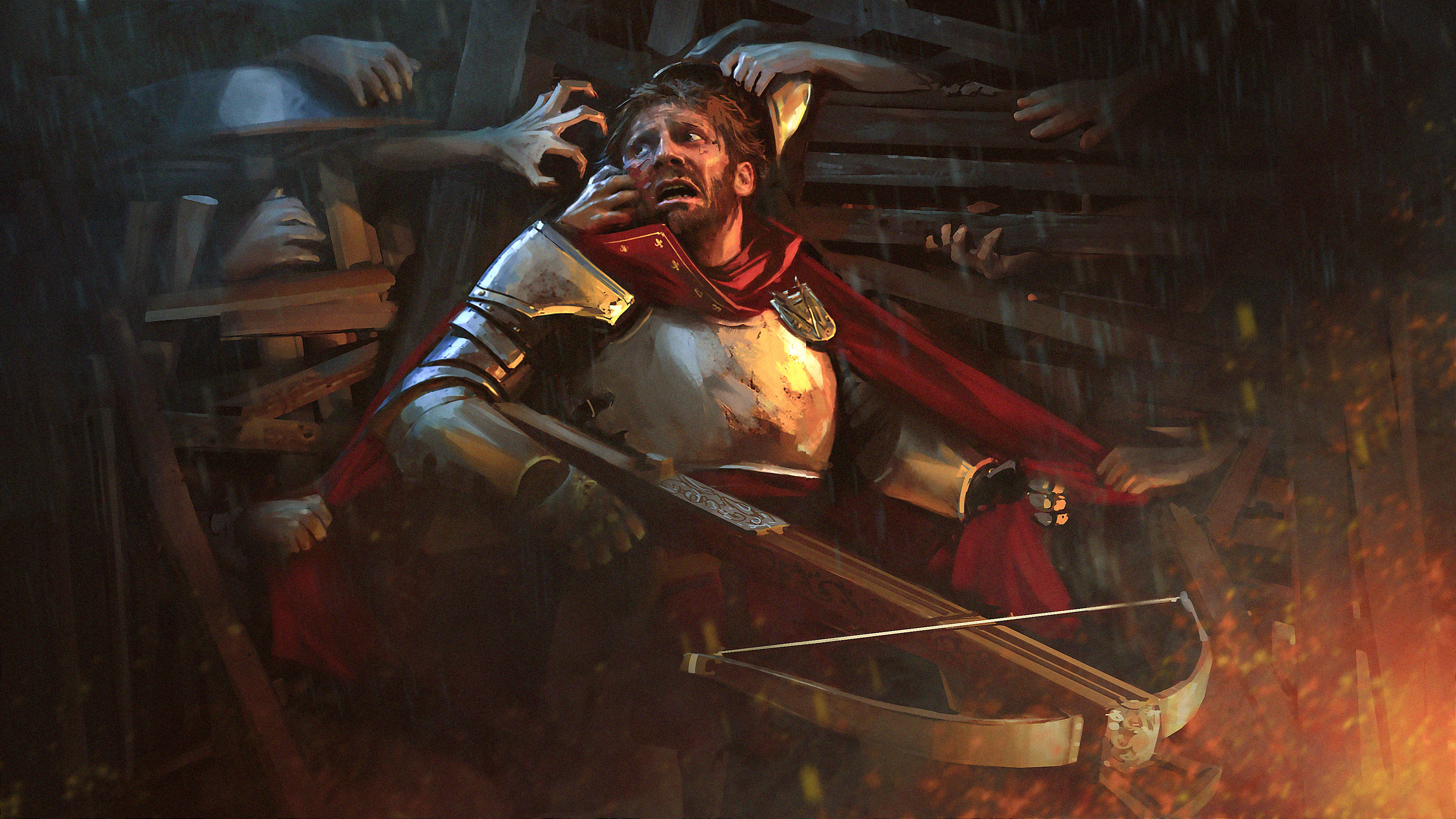
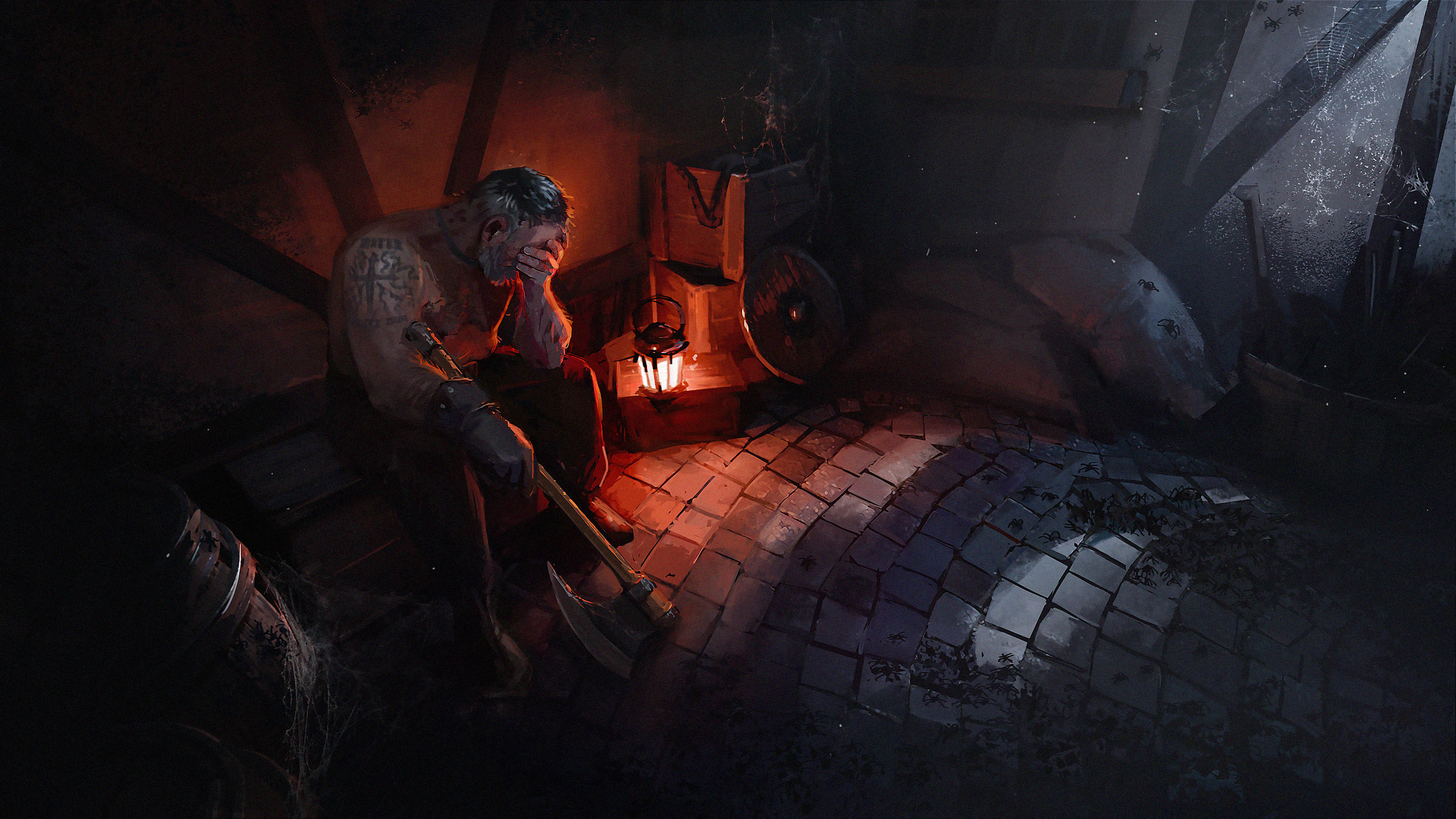
In the past, we’ve collaborated with some fine artists to bring you posters. This year, we decided to celebrate in two ways. First of all, our lead writer, Nick Adderley, who you may already know from last year’s The Coven of Abnoba, has penned a new story set in the world of Witchfire, The Ruin of Velmorne. Secondly, we asked the very talented Alicja Użarowska to create some beautiful pieces especially for the occasion, and we couldn’t be happier with the results – her work peppers the story below.
Devour the story, feast your eyes on the artwork, and consider it all a little Halloween treat while we continue working towards 1.0.
The Ruin of Velmorne
by Nick Adderley
Yeşna
Velmorne was crushed under the fog, suffocated by it. It pressed on the steep roofs till they groaned, spilled like woodsmoke through open doors and sent winding fingers through the cracks in windows. Mist as heavy as conscience – it boiled out of the sewers in rolling banks that blotted the moon, blotted out every cobble and shingle, every refuse pile in every corner of the city.
In Lowtown, a tosher was selling a jar of bull’s urine and cyclamens. His clothes stunk of sewage and his breath stunk of sack, and the pox-stricken mother who bought it knew he was lying when he said it was the last jar of Midwife’s Cure, found in a lost shipment at the bottom of the canal. She bought it anyway. She was due soon, and she didn’t have the strength on her own.
In the Upper Canals, the froth and spray and foam of the High Falls melted into the air; it dissolved before it reached the watercourse. Windows glowed in the damp, behind which merchantmen and caravan-part-owners shaved the coins of their servants’ wage by single candle-light.
But in the rich houses – in the Halls by the Sunset Gate and the paved galleries overlooking the vale – on Manor Hill, was the squeaking and rattling of the loom.
Yeşna licked her lips and fed the shuttle through the warp with pale, bony fingers. Flax dyed with weld; she pressed the treadles then stopped, and scowled. Her hands skittered over the thread, picking out the last line of the pattern.
The door knocked, then swung open. Anira entered the bedchamber with an earthen jar in her hand.
“It’s nasty wet out tonight and no mistaking, your ladyship. I have the tonic you commissioned from the leech. You told me to bring it you tonight?”
“You’ve been stingy with my thread, Anira.” The mistress’s head remained crooked over her loom. “It’s loose, it comes unspun…the color is pale. What, have you been pocketing the coin I give you for it?!”
“N-no, ladyship! You remember, when the spinners raised the price, I used me own wages –”
“No? Then perhaps it’s that bitch Niyara! Hm? Has she paid you to humiliate me like this?!”
“Let the girl alone, my dearling.”
Yeşna rounded on her husband. “Oh, you’re content, aren’t you? Content for our house to be a laughingstock!”
At a signal from her master, Anira bobbed her head, set down the tonic and fled, closing the door behind.
“Don’t let’s fight, dearling. We both know what comes next, with that tonic.”
Yeşna scowled again and took up the jar. Lumps floated in it, and it reeked of burnt hair. She pinched her nose and choked it down.
“What have you got this time?” he asked; his tunic rustled as he pulled it off. Yeşna gagged and shuddered.
“Everything. Anything. Niyara said she had her twins after a brew of weasel organs, so I had some added.” She slipped her shoulders out of her gown and let it fall around her ankles. “I’m sure the bitch was lying – just wanted to get me to do it. Well, I won’t give her the satisfaction of knowing one way or the other.” She blew out the candle.
“Oh, dearling…” he began.
“Save your breath. I can hardly stand the sight of you clad, you think I want to look at you with this garbage in my gut?”
The bed groaned as the master of the house sat on its edge, and spoke in a sullen tone. “If it’s such a burden, we needn’t bother tonight.”
She scoffed as she fumbled towards him. “Ha! Are you deaf, or a fool? Niyara had twins, I say, that’s nine to our eight! If I don’t match her, they’ll think I’ve become a…barren old crone.”
His doughy hand came feeling through the dark for her face and jammed a thumb in her eye. When she bit it, he struck her across the cheek and sent her sprawling to the floor.
Then there was a screech; and the fire in their hearts froze over.
Five throats, rent like rabbits at the slaughter. Like pinned rats, like cockerels; but those are inhuman things, and this scream rang, rang with the question of pain. It was heard from the Gold-fruited Mountains of the New World to the Jade Sea of the Heathen Orient: and it was sung by the mouths of children.
The master of the house flew over his wife in the dark, throwing the black maw of the door wide and hurtling down the corridor. Yeşna followed blindly. The squeals echoed through the Manor on the Hill. She struck her foot against a pillar as she passed, and a bloody nail chipped off it. A hundred thousand mothers wept about the world, their tears like pearls strung on its circumference. She limped, and came to the bedroom of her children. The steward held a candelabra, and pinned back a current of servants. The three boys huddled against the wall and wept from fear. Her husband stood, his hands twitching like dying snakes. Her five daughters thrashed in their sheets.
Between paroxysms, their skin looked scorched…black, or raw. They clutched at themselves in ecstasies of agony; their tongues, and eyes, but most of all they scratched at their wombs. “Father!” again and again they cried, “Father, get him off me! He’s on me, and he’s poison!”
He cried for a leech, and ordered help to pin them down; but the skin of his daughters scalded like irons. The steward was kicked over, but the light did not diminish. It grew; and Yeşna saw their flesh glow with the pounding of their hearts; as though red lead were pulsing through their veins. They thrashed and squealed, and begged for help. The sheets they twined around them smoked.
Yeşna grabbed the shoulders of her eldest, and shook the child through the burning of her hands.
“WHAT DO YOU THINK YOU’RE DOING?! YOU’RE SUPPOSED TO BE MINE! WHAT I MAKE YOU! SELFISH, SELFISH, SELFISH, SELFISH!”
She was hauled away, and the servants beat at the growing flames. Through the blur of her tears and the haze of her despair, she looked out a passing window. Velmorne was spread out below, invisible beneath its grey shroud. And yet it glowed: for in that mist, a hundred housefires twinkled.
* * * * * *
Dawyd
It was no longer a crowd through there – it was a mob. The roar of it leaked through the alley mouth with a sound like surf breaking on the rocks or the wind in forest boughs. Dawyd held his head in his hands and tried to think of anything else.
He stared down at the black cobbles between his feet; at the black wall across the alley and the black rubbish piled over a black sewer grate. Wind had scattered soot across the entire city, a dark snowfall, and rain had turned it to ink. Push aside a crate and a square of blue cobbles showed stark like a crack of light in a dark room.
Then had come the crawling Pestilence.
Tibalt pounced on one the size of Dawyd’s palm, batting it till its eight legs broke. He quivered for a moment, then dived forward again and bit its swollen abdomen. With the cat playing around his legs, Dawyd had a moment of peace; when an itch would only be an itch, and his recently shorn hair would birth no sudden skittering brood. But the dark shadows moved; through the hollow windowframes, over charred remnants, generations of them seethed and multiplied.
Dawyd stroked Tibalt’s coat, his fingers running over scabs. Where once they had thrown stones at the beast, now there was not a soul in Velmorne who did not know his name.
“You and I, brother,” said Dawyd, “We are two wretched men of low office, elevated in these dark times. How many more such will there be, I wonder?”
A pair of steel sabatons clanked through the alley mouth, and Dawyd flinched as he remembered the mob, and the work before him.
“To whom do I speak?” asked the Captain of the Watch.
“Dawyd,” said Dawyd. “Can’t you tell?”
Volodar groaned as he sat next to him, lowering himself in his plate. For a moment, they watched Tibalt gambling on the alley floor.
“We found where the cats went, you know. When we took this coven.”
“Coven? The oldest of them isn’t a grown woman yet, Volodar…”
“They’re brides of the Devil. They’re women now.”
The Captain was silent awhile. Dawyd thought for emphasis, but when he turned he saw that Volodar was searching for words.
“They were hiding in the sewers. We hunted through the…the crawling dark by lamplight. Małomir died first.”
Dawyd ground his teeth together.
“Not to the Pestilence, not even the things they created to hunt us. They’ve bred…weeds that hunger down there. A tangle of roots and grass…it stripped the meat off his leg before I could cross myself. Eighteen of my boys.”
Dawyd stood suddenly and began to pace.
“And when we found the chamber they were hiding in, we found the cats. Their paws spread apart and pinned down, their bellies cut open. Something red flowed out of them. If it was blood, they had changed it. Sharp. Hard on the surface of their entrails, like ice over mud. Surrounded with chalk markings. And the cats were still alive.”
Dawyd beat his bare chest once or twice. Volodar stood, tracking him with his eyes.
“I haven’t had time to tell Małomir’s widow. His daughters now, they remain pure. The curse didn’t fall on everyone. And they’ll go to bed tonight, and wake when their bedsheets crawl, and by morning there’ll be white eggs in their beautiful golden hair, because there’s no puss to hunt the Pestilence.”
Dawyd let out a bark, a cut-off roar, and swung round. He picked up the mad, impossible helmet the Latoner had crafted for him, and pulled it down over his head. Inside, in the dark, his hot breath rasped; gossamer stretched across his face. His hand found the haft of his axe.
“To whom do I speak?” asked the Captain of the Watch.
“The High Executioner,” he was answered. Together, they left the alley.
A scaffold was erected in the middle of the Lesser Square, and around it a makeshift barricade. Beleaguered watchmen held the line against the ebbing, roaring mob; a mob through which the High Executioner and the Watch Commander now began shouldering their way.
Most moved back, cursing them both. A few planted their feet, and were struck aside. As they approached the barricade, a rich woman named Niyara came forward, holding a wreath of flowers out to the Executioner. She wept. Behind her, other wealthy wives shrieked, and picked eggs out of their long hair, and watched her.
“A gift of gratitude!” she shouted through her sobs. “My daughter is the one in the red skirt. Take her first!”
Volodar took the wreath and pressed her aside. The watchmen let them over the barricade, and the High Executioner stretched at the foot of the wooden steps.
A stone resounded off his brass helm. He swept the mob with the blunt end of his axe, and they recoiled with broken bones; their screams were lost in the roar.
He ascended the scaffold, and beheld them: six in the new stocks. Four wept. The youngest reached, trembling and in vain for a straw doll on the boards beneath her chin. Dawyd would have called them children. The High Executioner called them witches.
* * * * * *
Volodar
The wagon leapt and rattled over the cobblestones, shaking its eight occupants to their bones. Six workers, a bound figure with a sack over its head, and the Latoner, cradling a brazen chest. It was in the middle of the column, drawn by sprinting watchmen down the street which runs from the Sunset Quarter to the Wharf. The horses had been slaughtered and eaten more than a month before.
At the head of the troop ran the High Executioner and his deputies, and their laughter was like echoing wells. Volodar ran beside them, his gut churning. Ahead, they could see shock on the faces of two men by the archway to the Wharf, nails glinting in their caps.
“Havok! Havok!” he cried, shouldering his crossbow. The High Executioner struck sparks from the cobbles with his axe. The two men of the Pinners’ Guild fled down dark alleys – and Volodar saw a young lad in a high window vanish. Their Master would know soon.
The lungs of the watch heaved as they surged through, and ran river-like across Pauper’s Bridge, which spans the harbor. And here, thought Volodar, they will await us: our only route back.
“Executioners, clear the way!” he called; and they ran ahead, as hounds before a hunt. When the wagon cleared Pauper’s Bridge, the headsmen had already stormed into Lowtown; the beggars there assembled fled shrieking into deeper refuges of darkness.
“Rearguard! Detach and mind the bridge!” And the last unit of watchmen dropped with heaving breaths into cover, peering over their crossbows at the Wharf.
As the wagon trundled into Lowtown, Volodar spared a last, long glance across the harbor. All was silent; not a figure moved. There could be no clearer proof that the Pinners were already mustering for ambush. He turned and followed into the courtyard.
“Corner them! Over there, by the well!” he shouted. The headsmen acted as sheepdogs, nipping with their axes, forcing back the crowd of beggars; who wept, and clicked, and scratched at their sores and monstrous new features. The Watch Commander blanched and covered his mouth. “Against the walls! My lord High Executioner, stay where you stand – any who come within reach of your axe, let them be slain by it!”
The workmen had already been disgorged from the wagon. They seized pallets, broke apart crates or window shutters and began nailing them over the many arches leading into the district. The Latoner licked his lips and fidgeted with the chest.
“Forget your pride!” said the Latoner. “Cover the entrances, my craft will do the rest!”
A voice from the crowd cried for Volodar. When the Watch Commander turned, one old woman stood apart, not pressed against the walls as the others were. Her eyes were split into many sickly beads, and nameless new bones were thrust out through her skin. “Our rations are not enough,” said she, “and we starve! The beasts grow swollen at the bottom of our well, and there is no water left for us! We thirst! We thirst!” But so saying she stepped forward, and the headsman’s axe flashed in an arc. Blood the color of bile ran down the blade, and the crowd screamed and recoiled.
“I will not poison Velmorne to save its beggars!” cried Volodar. “When the plague has run its course, any who yet live will be welcomed. Indeed, I will give them each a fine house! Till then, you shall not mingle. Latoner? Have you finished?”
Every entrance to the Beggars’ Quarter was now sealed; ramshackle blockades of dry, splintering wood. To each of these, a black iron lock had been affixed, chiseled with runes the color of embers. The Latoner turned a key in each, of like fashion, and the air between the boards shivered as above a candle.
“We have only the last, my lord!” he answered.
The Executioners hauled the wagon out of the Quarter, and like the cracking of a dam the crowd of beggars came spreading across their district. They tried the rotten barricades and found them hard as steel – then they understood, and came at last towards the final archway as the workmen nailed it closed. Their half-rotted hands thrust out through gaps with the frenzy of a wolf in a trap, and the Executioners braced their axes against the timber to stem the tide. The Latoner affixed the lock.
One screech from the swell of plague-flesh rose above the others: “Save my son.” And a screaming infant was thrown over the mob, through the top of the barricade, and landed stunned on the cobbles. Volodar’s breath caught, and he held, paralyzed. His watchmen reeled back. The child’s skin was unblemished.
The High Executioner took the infant by his ankle. “As you said, Volodar,” his voice came smiling, but rang in his helm like a knell, “none in Lowtown are untouched.” And so saying, he flung the child back across, and turned the key in the lock.
The Watch Commander’s jaw hung slack; and for a moment, he was as stricken as any fresh recruit. It was the Latoner who broke his reverie.
“That’s my service ended, Volodar. You have your keys, Lowtown and the Beggars’ Quarter are sealed. Now keep your end of the bargain!”
Volodar shot a venomous glare at the Latoner, then turned and surveyed the Bridge across the Wharf. Not a soul stirred on the other side.
“No one in, no one out. You know that.”
The Latoner started forward, then stopped. “No. No. Don’t you fucking dare. You know I’m not sick with it, you promised you’d make an exception and let me leave the city!”
The archway. Perhaps the far end of Pauper’s bridge, that would hold most of them. “Consider yourself lucky you’re useful. Believe me, I’d much rather have you beheaded like the rest of the witches.” He looked at the Latoner. “Perhaps one day I’ll get the chance.”
The Watch Commander stepped forward into the open, took off his helmet and shouted till his voice echoed around the Wharf, and drowned out Lowtown’s weeping. “Tretyak! Let us pass!”
The voice of the Guildmaster issued invisibly into the harbor: “You’ve passed over the territory of the Pinners, Volodar. You belong to us, now.”
The Watch Commander motioned, and his men took the bound figure out of the wagon. Volodar swept the sack off her head, and she stood blinking in the sudden light.
“Guess who came suing for peace between the Watch and the Pinners? Don’t worry – we’ve done nothing to her yet. As far as I know, she’s even still a virgin.”
A long silence grew. Tretyak’s daughter sniffed and twisted in her binds; the watchmen tensed the triggers on their crossbows. At last, the Guildmaster of the Pinners emerged with a lieutenant at his side, his clothes glittering with nail-heads. His voice was hoarse.
“What do you want?”
“Safe passage. Tell the men you have poking at the Sunset Gate to leave off. And I want back the granary in the Upper Canals. Return the supplies that were there…or for everything that’s missing, I’ll take something from your daughter.”
“What insurance do you give?”
“Take your fucking chances.”
The Pinners conferred, then withdrew into the shadows. Volodar wrapped her ponytail around his gauntleted hand, pressed the quarrel of his crossbow into her back, and began to walk. “Form up, lads!” he shouted, “Same way we came in!”
They trod warily over Pauper’s Bridge. When they passed under the arch, not a soul was to be seen. The column returned without incident to the Barracks, and the Watch Commander retired to the walltop. There, in solitude, he vomited; and then wept.
* * * * * *
Khoryv
The Upper Canal was dammed. A thin sheet of murky water poured over the top, and a few choked streams gurgled out through pores, but the canal behind it was swollen almost to the street level. It was dammed because of a common instinct: there are better deaths than the plague. Climb the High Falls, drop, and if you’re lucky drowning needn’t enter into it at all. Like hanging, Khoryv reflected as he picked his way over the corpse bridge: if the neck doesn’t break, the strangling finishes you off.
He lifted a water-bloated hand, and began tugging at the jeweled rings around its fat fingers. Like hanging, too, there was a sense of fraternity. You join the beautiful line of gallow-fruit on the scaffold’s branch, become the newest entry in the honored history of the hanged. Here, you’d be washed, blind, senseless, into the great construction that others before you had made, thinking in the same way. It was a shame they wanted him to remove it, really. The finger popped off the hand. Khoryv shrugged and slipped the ring off backwards, pocketing it. His open vestments breathed the sweet, spiced scent of his unguent across the smell of rot.
“We drink from the Canal downstream of here!” Tretyak made his case from the east bank, surrounded by a retinue of Pinners. “If we catch the plague, it will only continue to spread! Will you butcher the city just to burn your rivals?”
Volodar scoffed from across the Canal. “Indeed, without the Pinners’ Guild, who would sell false cures and put robbers in the archways? You are a greater blight than any pox, Tretyak!”
“Then come to the Oath Tree, and try to be cured of me!”
“Enough!” Khoryv’s reedy voice was almost inaudible, and Volodar made to respond; but the undertaker stooped, and ripped a handful of plague flesh from a nobleman under his boots. It came off easily, as baked meat. He held it in his glove as though to throw, and the Watch and Pinners both recoiled from the bank. Khoryv grinned.
“I tire of this conversation. What will the Pinners give me to remove these bodies?”
Tretyak peered down, and then gestured. A young woman was pushed forward at the point of a long oaken stake.
“This girl, for your diversion!” She sobbed, but said nothing.
“Oh, look at the thing!” Volodar shouted, “They won’t touch her, she’s half dead from the plague already! She’s sprouted ants’ jaws!” And so she had – two new protrusions from her cheekbones, and her skin speckled all over with scabs and rigid hairs.
“Do not presume to know my appetites, Watchdog!” called Khoryv, giggling. “What do you offer?”
“Leave the blockage, poison these curs, and we offer you wine: the last barrel of sack in the city, full to the brim.” It was rolled to the rim of the Canal.
“Oho,” quoth the undertaker, “Let us taste!” He picked his way over the flooded corpse-way. Once his foot went through, and the spectators winced, but at last he reached the western bank. An earthen cup was left beside the barrel and the Watchmen withdrew. Khoryv drank.
“You have cut it,” he growled. Volodar wavered.
“Velmorne is drunk dry,” he said, “be so particular, and you will remain sober till Judgment Day!”
“We have ale, as well!” called Tretyak, “In bottles sealed since the fire!”
Khoryv wheeled about. “How much?”
Tretyak conferred frantically with his retinue. “Six pints!”
The undertaker let fall the cup and returned across the mass of dead. “For six pints of ale, and the woman, I will clear these corpses. Bad luck, Watchdog! But save the sack – I’ll have it from you when Vale Street wants clearing…hah hah!”
The Watch Commander swore quietly, retrieved the barrel and left. On the eastern bank, the Pinners’ Guild drew back as the undertaker stepped out of the Canal, and with squashing dripping steps encircled the girl.
“She is well!” he growled. “Bring her to my court, along with the ale. Be sure she does not escape before my return; what I remove, I may replace.” And so saying he took up his spade, and dug it into the bank of corpses.
* * * * * *
Yeşna
She chewed, and impulsively turned the thread in her hand, laying another line in the pattern. She had to be watchful – there was no telling who might show up. She thought she’d seen Niyara dead, but then, she’d thought she was dead too.
She wasn’t. She was becoming young again. First her vision had become clearer…so sharp that daylight burned her eyes. So she went into the dark places, the sewers and the cool caves, the lovely cool caves. Then weaving had become easier, oh yes, much easier, more natural – and she didn’t have to rely on that idiot serving girl to fetch her more thread now, no. She spun the pale lines herself, like strands of moonlight in the dark. She paused her chewing to squeeze, and when the spasm had passed, she took another bite.
After that, birthing had become easier too. No longer months and months, but every day her brood grew by dozens. And her children were beautiful. They walked the moment they hatched now, instead of months after. When the others learned, how jealous they’d be!
Unless Niyara was growing younger too. A surge of panic shot through Yeşna, and she let herself down to the cave floor, pressing herself to her progeny for warmth. The half-wrapped bundle in her hands mumbled deliriously. “Dearling…” it said. She stung it again to make it quiet.
She started. A red light. A growing light. Blinding, too bright. Yeşna hissed and drew back…and the light was gone. In its place was a woman. She’d been an important woman, once.
Helena looked around the dark cave, smirked as Yeşna’s young skittered away from her in fear. At last, she turned her gaze to the Widow herself.
“By the powers, aren’t you a sight? You must be pleased. No woman has ever bred nor woven as much as you now, Yeşna.”
The Widow made no answer. A dim gladness entered the corner of her mind – if the woman told the truth, then Niyara wasn’t a threat anymore.
Helena surveyed her handiwork a moment longer, and seemed almost sad.
“And yet I could pity you. Woe for Yeşna of Velmorne, mother of skittering thousands; who has never known the joy of children.”
And Yeşna of Velmorne, mother of skittering thousands, did not understand.